
Five small dams failed during the widespread flooding in northern Michigan this month and five others with the ability to cause major downstream damage were on the verge of failure, Michigan's dam safety supervisor told a House legislative committee Wednesday. "The reality is that it's not a question of if another heavy rainfall or flooding event will occur," said Luke Trumble, who manages the ...

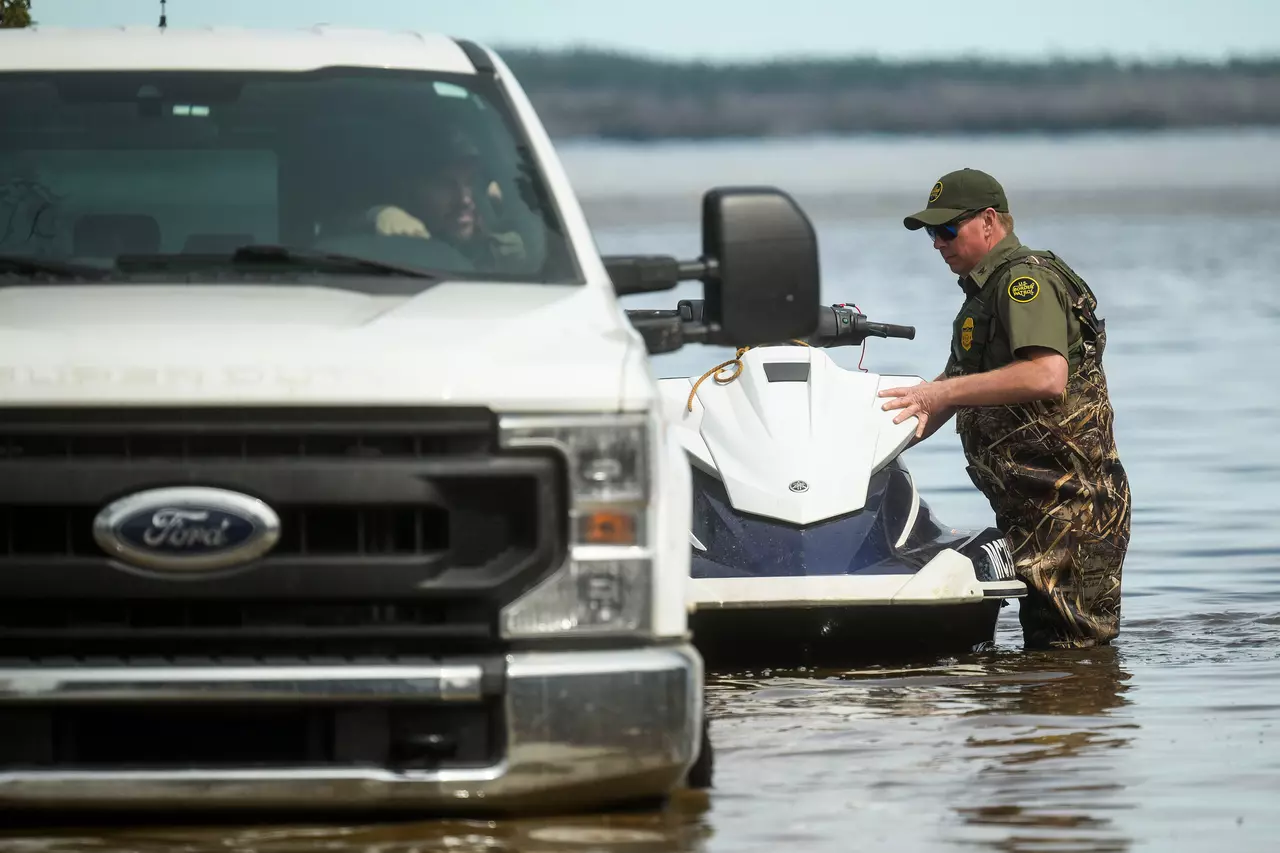
A U.S. border patrol agent loads a personal watercraft back onto a hitch hauler after taking it out on Black Lake while helping other law enforcement agencies looking for homeowners who may need help evacuating on April 17, 2026, in Cheboygan, Michigan.
Katy Kildee/The Detroit News/TNS
Five small dams failed during the widespread flooding in northern Michigan this month and five others with the ability to cause major downstream damage were on the verge of failure, Michigan's dam safety supervisor told a House legislative committee Wednesday.
"The reality is that it's not a question of if another heavy rainfall or flooding event will occur," said Luke Trumble, who manages the Michigan Department of Environment, Great Lakes, and Energy's Field Operations Engineering and Enforcement Section, which includes dam safety. "It's when. And will we be prepared next time?"
Trumble testified Wednesday in front of the state House Natural Resources and Tourism Committee in support of legislation proposed by state Rep. Bill Schuette, R-Midland, that would strengthen the state's dam safety standards.
The bill would raise the required spillway capacity for major dams, increase inspection frequencies, require dam owners to show they have the finances to safely operate their dams, would set up a fund for dam risk reduction efforts and make other changes to dam regulations and EGLE's dam safety program.
The bill strengthens EGLE's oversight of dams by giving the department jurisdiction over all dams in the state. Now, the U.S. Federal Energy Regulatory Commission solely regulates hydropower dams in Michigan. The bill also calls for increased inspections and raises the legal requirements owners must meet to operate dams that pose a high and significant downstream hazard, Schuette said.
Some committee members pushed back against Schuette's proposal, accusing EGLE of placing burdensome regulations on infrastructure projects, raising concerns about the cost of implementing the changes and questioning whether the department would prioritize removing dams over maintaining the lakes they create.
...
A home on North Black River Road along Black Lake is surrounded by floodwater on April 17, 2026, in Cheboygan, Michigan.
Katy Kildee/The Detroit News/TNS
Rep. Jennifer Wortz, R-Quincy, said the legislation would place an unfunded mandate on local governments, counties and landowners.
"I again have serious concerns about the cost to do this," Wortz said. "I don't argue the need for, obviously, (updating) outdated infrastructure."
Some local units of government own dams, such as the city of Beaverton, which owns the Beaverton Dam on the Tobacco River and generates hydropower from it.
Schuette said his bill deals with policy instead of funding and while it would establish a fund for grants and emergency dam safety work, it would need to be funded by future legislative action. He said it is incumbent on the government and dam owners to ensure dams are safe.
"If you cannot maintain the resources to operate or own a high-hazard dam, you should not be operating a high hazard dam," Schuette said. "If you're not able to keep the people downstream safe and you don't have the resources to do that, you're jeopardizing the lives and livelihoods of thousands."
The committee did not vote on Schuette's bill. Committee Chair Rep. David Martin, R-Davison, suggested hosting a workshop where parties could deliberate on some of the issues raised at Wednesday's hearing.
Northern Michigan flooding highlights dam safety problems
Michigan's dam safety issues are on full display as northern Lower Peninsula communities continue to deal with the effects of widespread flooding that inundated the state early this month.
Gov. Gretchen Whitmer issued an emergency declaration for almost half of Michigan's counties because of flooding and severe weather mid-April and federal energy regulators said they have "significant concern" about the state of some northern Michigan dams.
...
A U.S. border patrol agent navigates a personal watercraft out of Black Lake while helping other law enforcement agencies looking for homeowners who may need help evacuating on April 17, 2026, in Cheboygan, Michigan.
Katy Kildee/The Detroit News/TNS
The flooding loomed over Wednesday's hearing, as did the Edenville and Sanford dam failures of 2020. Schuette represents central Michigan, where floods swept away homes and businesses after the dams failed.
Those dams were owned by Boyce Hydro, a private company that lost its license to generate hydropower from the dams because it had allowed them to fall into disrepair. An independent forensic team later determined the failures were foreseeable and preventable, but didn't place blame on a single party.
"This was a true clarion call and it is clear we need a better framework for the communities and local job providers (so we aren't) taken down this path again and taxpayers aren't left footing the bill for something that occurred through no fault of their own," Schuette said.
Lawmakers created the Michigan Dam Safety Task Force after the Edenville and Sanford dam failures.
The task force issued 86 recommendations. EGLE changed its dam safety work as a result, with steps such as adding staff to the program and taking stricter enforcement action against owners of problem dams.
Former state Sen. Rick Outman, R-Six Lakes, proposed legislation to fulfill the task force's recommendations that required changes in state law in 2021. The bipartisan bill did not gain traction in the Legislature.
Members of the task force have recently criticized lawmakers for failing to act as floods push dams to the brink in northern Michigan.
"It’s kinda like you were in a big accident and the Legislature just wants to hand you a Band-Aid," Bill Rustem, a task force member who has advised multiple Michigan governors, told The Detroit News.
...
A U.S. conservation officer paddles a kayak between homes surrounded by floodwater along Black Lake on April 17, 2026, in Cheboygan, Michigan.
Katy Kildee/The Detroit News/TNS
Schuette's legislation mirrors recommendations developed by the Michigan Dam Safety Task Force.
FERC orders inspections of northern Michigan dams
The U.S. Federal Energy Regulatory Commission, which oversees hydropower projects, ordered companies that operate hydroelectric equipment on some northern Michigan dams to assess their equipment since the dams were pushed to the brink by the historic flooding that hit Michigan this month.
FERC engineer Marilyn Sabido ordered Thomas Homco of Hom Paper, which FERC identifies as the owner of the Cheboygan Dam's hydropower equipment, to have a professional engineer conduct a comprehensive structural assessment of the dam's powerhouse, spillway, embankment and navigational lock because of the flooding.
She credited the "heroic efforts" of workers from Consumers Energy, the U.S. Army Corps of Engineers, state and local officials and HydroMine, which leases the hydropower equipment from Hom Paper, for preventing the Cheboygan Dam from overtopping by bringing a turbine online to pass some water downstream.
Sabido also said Homco must also take steps to fully restore the hydroelectric equipment on the dam. It hasn't operated since the adjacent Great Lakes Tissue Company caught fire in 2023. FERC is pressuring Hom Paper to restore and operate the equipment, but has granted delays because Hom Paper and HydroMine are negotiating a sale of the equipment.
Water reached close to the top of the Cheboygan Dam this month as snowmelt and rainfall caused widespread and disasterous flooding across much of Michigan. Part of that pressure was caused by upstream dams, such as the Kleber Dam, where floodwaters eroded a spillway and put additional pressure on the Cheboygan Dam downstream.
...
Michigan State Police bring their boats in from Black Lake after looking for homeowners who may need help evacuating on April 17, 2026, in Cheboygan, Michigan.
Katy Kildee/The Detroit News/TNS
The operator of the Alverno Dam, also upstream of the Cheboygan Dam on the Black River, asked the DNR to help remove debris from the dam gates, the DNR said in an April 16 press release. Responders discovered the dam had breached around 11:30 p.m. April 15. They worked through the night to place sandbags on the dam to prevent it from failing.
Black River Hydro LP, which operates the hydroelectric equipment on the Alverno, Tower and Kleber dams on the Black River in Cheboygan County, did not have an engineer on site during the flooding, FERC's Sabido noted in an April 23 letter to the company.
Energen Renewables owns those three dams, said Brett Trepanier, president of the Black Lake Association. Black River Hydro operates them.
"Continuous and capable engineering oversight from the licensee is required during high‑flow events and emergency conditions," FERC regional engineer Marilyn Sabido wrote to Black River Hydro on April 23. "The absence of engineering expertise from the licensee presence raises significant concern regarding operational awareness, adequacy of staffing, and compliance with required project oversight responsibilities."
Sinkholes developed at the Alverno Dam's middle embankment, leaks and erosion risk occurred at the Kleber Dam's spillway and the Tower Dam's gate was stuck, among other issues, Sabido said in the letter.
She ordered Black River Hydro to explain why there it had no professional engineer at the site during the flood and said the company must re-evaluate the dams' hazard ratings, which reflect the potential consequences of dam failure. Currently, the are rated low-hazard potential dams.
...
Michigan State Police bring their boat in from Black Lake after looking for homeowners who may need help evacuating on April 17, 2026, in Cheboygan, Michigan.
Katy Kildee/The Detroit News/TNS
"Given the seriousness of these conditions, all three developments must be inspected and assessed immediately by a professional engineer with dam safety experience," Sabido wrote. "The engineer must evaluate the performance of the project structures following this high-flow event and provide recommendations to ensure safety of the projects for continued operation."
________